Monday, 6 February 2012

Dear Johanna

I cannot think of my first post without shame. In it, I described New York city as a tourist would: its sights, sounds, smells--all described with the detached voyeurism of an observer free to enter and exit its borders with impunity. Well, today showed me how wrong, how incredibly wrong, I was. New York is no longer faceless. It has a name, it has a face; her name is Johanna.  [NB: For reasons which will become clear, I have changed the names in this post].

And I cannot forget her. I close my eyes and I see hers, deep blue, huge in her thin, lined face; her smile---dissembling, in that only after two or three seconds do you realize its radiance is not that of joy, but of pain, and a despairing resignation to its inevitability. Then the reddened gums seem as bloody emblems of that pain, hopelessness bleeding starkly into the whiteness of her teeth. Then her smile reveals itself to match her eyes, and within their deep chasms is a like pain, a like pleading for something that, she hopes, you can give. 

I simply cannot write this as a typical blog post. It's too raw, too real, too unworthy of being placed alongside my others. I will only say that Johanna was sitting on the step a few buildings away from mine; no, not sitting, cowering. Her head was hid in her hands, a red coat sprawled across her knees for warmth. On the arm shielding her face, I could see a hunk of cotton gauze protruding from underneath her sleeve, sloppily taped to an arm far too insufficient for cover. She was crying. I stopped, and asked what has to be the stupidest question of all time, "Are you all right?" 

Of course she wasn't. I think part of me wanted her to say she was. Part of me wanted her to shoo me away, absolve me of any responsibility, leave me free to finish my run and stretch in perfect contentment, having at least showed the "decent" level of compassion by stopping in the first place.

When she raised her eyes, I saw the deep purple bruise, deep enough, bright enough, and even enough to be mistaken for some shade of horrid eyeshadow--except it was only on one eye. She closed her eyes, bit her lower lip, and shook her head. I sat down next to her, and another girl my age, seeing us, stopped, turned, and asked me kindly what was happening. Angela. We asked Johanna if there was anyone we could call, but she was unable to remember any number; each time she tried, and failed, she would lower her face to her coat and begin crying again. She had no family in the city, she said, and friends--well, she could not stay with friends; she had to go back. He wouldn't like it if she didn't.

We learned that she had walked tens of blocks from where she lived with her boyfriend. But she couldn't say what I already knew, what I guessed from the bruise on her eye and those on her arms. She didn't have to. "He, he, he,..." I will never forget the way she looked in my eyes, telling me more clearly than she could have with words what exactly he had done. I answered her in the same fashion; I knew. "He's not a bad guy, he's not a bad guy, he's a good guy..." 

Mindful of the advancing cold, Angela suggested going to the cathedral half a block away. Surely, a church--a  cathedral--would be able to provide some support, if only in the way of a blanket and some telephone numbers. Johanna was hesitant. She explained that she was alcoholic; her boyfriend was too. But both things were said as if she were a living contagion herself, a plague that no one would want to see, much less care for.  Every week saw another relapse, every week hopes dashed, her alcoholic pit becoming ever and ever deeper.

I cannot help but feel contempt for myself when I say that I saw a bit of myself in her when she said these words. How often have I despaired over the very same sin, cried out to God with the very same lament as a few days before? How often have I accepted my sin as irredeemable, disdaining God's power to transform and sanctify? Yet I told Johanna, my hand rubbing her back, that I too was broken, and relied on God to bring me through--as He always does. Yet I say I feel contempt, that I, a broken yet thoroughly privileged vessel, could compare my pain with hers, her whose face showed years of facing an utter impossibility, drained of the youthful bravado and naive optimism that such impossibilities exist only to be negated.

Yet I still cannot believe how the Holy Spirit used my poor attempt at comfort to stir something within her soul. "God, God, that's what I need. That's what I need, isn't it?" Yes, I told her, that's what we need. 

I desperately poured through my brain for scripture passages that would help at this moment. Forgoing other, much more relevant verses that would only emerge after a fifteen-second delay, I said the verse was from Isaiah. "I know what verse you're going to say," Johanna said, with a sad, mocking smile. But she couldn't remember. Jeremiah. Jeremiah what? Jeremiah...Jeremiah 14:29. I don't know that particular verse, I said; the one I was thinking of was Isaiah 40:31: "But they that wait upon the Lord shall renew their strength. They shall mount up with wings as eagles, they shall run and not be weary, they shall walk and not faint." I quoted it to her, and for the first time her smile seemed, perhaps, to be one of joy. She asked me to write it down, but I didn't have anything to write with, much less on. 

I asked her if she would like me to call my pastor, who is in charge of my church's mercy ministry; I was sure he would know some resources for her. To my unbelieving surprise, Johanna nodded eagerly, and Angela stayed with her while I went to get my phone. But I didn't have his number, only that of the other pastor, who wasn't answering. No one was answering. I called everyone I knew from the church in my contacts list, widening the net more and more, getting farther and farther removed from my goal, just to find someone who had his number, or someone who had someone who had his number. No one answered. 

I returned to Johanna and Angela--the former, with a Coors Light in hand. She must have had it hidden in the folds of her coat, and was drinking desperately, as if it was the one motion that she knew how to do. But even this was beyond her grasp. She dropped the can, spilling the noxious stuff all over the sidewalk. It ran down from step to step, dripping, dripping, each drop, I thought, a bit of life ebbing further away from the figure in front of me. Drip. Drip.

Finally, one of my friends called back, and we began contact calling for the golden number. Right before my phone died, we got it. But it was then I realized all our efforts had been in vain: even if we did get the number, it wouldn't matter; the pastor was at that very moment leading a church service that had started ten minutes  before.  

It was then my turn to wait, as Angela went to her apartment to drop off her things, brew a cup of tea, and grab a small bit of food. While she was gone, I asked Johanna if she would like me to read to her from the Bible I had brought out with me. She nodded, and I turned to the Psalms. I explained how I often turned to them in my own despair, and began reading with a passage I thought she might find familiar. "The Lord is my Shepherd, I shall not want. He makes me to lie down in green pastures, He leads me beside the still waters. He restores my soul; he leads me in the paths of righteousness for His name's sake. Yea, though I walk through the valley of the shadow of the death, I will fear no evil, for you are with me. Your rod and your staff, they comfort me." You are with me. They comfort me. 

Somewhere in the midst of the Psalm, Johanna fell asleep. 

Angela returned, but we still didn't know what to do. We could not leave Johanna. We couldn't even take her somewhere. I had suggested earlier going to the church itself; she had tried, willing her bird-like frame vertical. But all it did was throw her emaciated legs, the brown stains on her pants--from her bloody nose, she said--into starker relief. She couldn't walk the ten blocks to the church; she couldn't even stand. 

And the cathedral--what would Jesus say? How he would cry to think that the most a building made to worship Him could offer was a black-and-white pamphlet with local food banks, and a woman's dismissive suggestion that we try dialing 3-1-1, the NYC government information and services; "good luck" trying to get a hold of anyone at any of the decent shelters, she told Angela. I nearly wept. 

While Johanna slept, Angela and I deliberated. In the end, I was sent to my church to find someone, anyone, to help, while Angela stayed with Johanna, outside in the freezing cold. But the service was already in progress, and the pastor had already begun his sermon. How cruel, the irony that a woman's life may be hanging in the balance, and the only help I could think couldn't, because he was preaching. I sat on the steps leading into the sanctuary, hearing his voice mercilessly echo off the Gothic arches. It is no exaggeration: each reverberation wrung my increasing angst yet one degree tighter.

Just when I was about to give in and despair, some other people came, people who gave me some local contacts. Yet they urged me in this case to dial emergency medical services, in order to ascertain that Johanna hadn't sustained a concussion or internal injuries. My phone having long since died, I used my roommate's to call Angela and give her the news; she would call 9-1-1, and see that Johanna was given the care and information we could offer. 

After the service ended a few minutes later, the pastor dropped everything and came with me back to my street, and to Johanna and Angela. But we were too late. Johanna was already loaded into the ambulance, and there was no one around. Angela had called to tell me that the paramedics had arrived and taken Johanna in their care; there was nothing more for her to do, so she had gone. But I couldn't see anyone now. The lights were flashing, I could Johanna's unconscious head lying on a bed, through the window. But there was no one in the cab, no people to ask to tell me how she was, what I could do. I presume the paramedics were in the back with her, but I couldn't see them. Once again she was trapped, it seemed, once again lost to the world with no one to help her. 

The pastor said he would stay for a few minutes, hoping that someone would emerge from the ambulance. I realized there was nothing I could do; the paramedics couldn't even tell Angela to which hospital they were taking Johanna.  

So I left. I left, to prepare the party I was hosting at my apartment, the party where we would eat, drink, laugh, joke; where we would do all the things that good Ph.D. students are supposed to do in lieu of a proper, scorned Super Bowl celebration. And it would last longer than two hours, longer than the time I spent with Johanna. As it was supposed to do. As I supposed to do.

As people are supposed to do. 

Saturday, 21 January 2012

Baking Grace

To those who found the preceding post far too abstract, I apologize. I know that few people may want to read the thematic ramblings of a crazed grad student who suffers from a mental illness in which she connects utterly dissimilar events, objects, and quotations to eachother in a late-night blog post. Hopefully, though, for those of you of this ilk, this post will seem slightly more fulfilling. 

Let's face it: New Yorkers have a reputation. I see it played out before me every day. Especially when I go grocery shopping. You see, rather than pay the outrageous Manhattan prices, once every few weeks I make the trek to Shoprite in Brooklyn. It's at least a three-hour adventure, assuming I have a grocery list in hand and the lines aren't too long. But I make up the price of a metro trip in a couple of cans of diced tomatoes, so I think it's worth it. Plus, I get a cultural experience. The first time I went, I had barely wanted in the door when a lady with a strong Brooklyn accent held out small votive candles and asked me, "You want some Shabbos candles?" My befuddlement was clearly visible (though I did know what "Shabbos" was): "You're not Jewish are you?" she commented. Umm, no. She walked off, rolling her eyes as if to say, Great. One of them again. Yes, I'm one of them, as evidenced by the fact that I spent nearly fifteen minutes circling the store in search of ground pork.

Then there are the checkout lines. The magazines that would normally advertise everything from Marie Osmond's latest of weightloss treatment to the best way to baste your turkey are covered with black pieces of plastic, no doubt in consideration of the Orthodox Jewish inhabitants. 

But my favorite Shoprite cultural moment? I was just about to check out, when I saw a wizened couple shuffling the other way. They were at least 60, bearing the marks of a long and familiar existence, and the wife was scolding her husband in the thickest New York accent I had ever heard. "You didn't get the can of beans? I thought I told you to get the beans..." I couldn't help but think, It's true! Jewish mothers, they're real! It could have been a scene straight out of Seinfeld

But perhaps the thing New Yorkers are most known for is their, ahem, hospitality. New York drivers, New York soup Nazis, we've all heard about them. So it was with complete astonishment that I experienced a fragment of commercial hospitality that I have a hard time imagining happening even in relatively cozy Rochester, MN. I had gone into my little corner housewares store to get a baking sheet on which to make homemade bread. You know, one of those tiny Manhattan housewares stores that are about two feet wide and twenty feet deep? But I had stopped unexpectedly at another store right before to get a just-remembered item, and I consequently lacked the cash necessary to buy the pan of the ideal size I wanted. But I didn't realize this until I was at the cash register. I apologized, and moved to exchange the pan for a smaller, cheaper one commensurate with the cash funds in my hand. 

"Don't worry about it," the shop (owner?) drawled, waving his hand in a laissez-faire dismissal not compatible with laissez-faire economics. "I'll just mark how much you owe on the receipt, and you can bring in the difference next time." 

My jaw dropped. He was spotting me the money? Here he was, a man I had never even met before, much less knew, forgiving the $2.87 I owed him and trusting me to come pay him back? He wrote the total down on the receipt, with such nonchalance that I guessed he knew he may not see the money again, but still wasn't bothered by such a loss.

I returned to my apartment, a few blocks away. And don't worry, I did return to the shop a few days later, when I returned the $2.87 along with the value of another purchase. The guy who had forgiven me the money wasn't there, so I have it to a different cashier, who look confused at my action. I guess he doesn't ordinarily have people give him more than what is written on the receipt. 

Perhaps, I reflected, he was just as confused as I was. I had not expected a businessman, and a New York one at that, to show such faith in a complete stranger. He forgave my debt and let me buy my pan, despite the very likely possibility that he would never recover the money. Yet I could hardly believe it. Maybe it is not so strange then, that the second cashier was so bemused. Perhaps he did not expect the recipient to appreciate that grace, any more than I expected to receive it in the first place. Yet I returned with the money, and from now on I try to shop at that store whenever I need something of the kitchen/housewares type.  Who knew that grace would so exceptionally descend, and that it would come in the form of a baking sheet?

Friday, 20 January 2012

Maggots and Monuments

Let's face it: many--perhaps even most--artists are parasites. Just look at Shakespeare: Of his plays, almost all borrowed plots from older sources. Yet most of us would be hard-pressed to cite Boccaccio for Romeo and Juliet, or even Plutarch (translated by Thomas North )for Julius Caesar or Antony and Cleopatra.

Admittedly, Shakespeare (yes, for once and for all, WILLIAM SHAKESPEARE, not Edward de Vere or some other conspiracy theory crank) amalgamated, rearranged, and lyricized his sources in such remarkable ways as to make him utterly immortal. Ben Jonson declared in his preface to the First Folio, the first collected volume of Shakespeare's works published in 1623,
"Thou art a Moniment, without a tombe,/And art alive still, while thy Booke doth live"
 But still, my point is that imitation, intellectual thievery, allusion--whatever you want to call it, it's a part of the act of creation. I had to laugh today when I read Margaret Cavendish's view on the subject. She's not exactly a household name, but I find Cavendish intriguing, not just because she was a published female writer in the mid-seventeenth century, or even because she was a royalist at a time when Charles I, the king of England, had lost his grip on the country--and on his head (courtesy of Oliver Cromwell and his associates). Mostly, I love/hate her because she was utterly shameless. She had her opinions, and she published them loud and clear--most of which involved her own exceeding adequacy in relation to others' utter inadequacy. Just take this bit: towards the end of Nature's Pictures, published in 1654, she includes a cute little story in which the Olympian gods are determining which books to keep in their library of Fame and which ones should be cast into Hell to be burned, or else drowned in the river of oblivion. Cavendish declares that none of her contemporaries' work should be saved,
for most of the moderns have been like a company of Ravens, that live upon dead carckasses, so they upon old Authors, and some have been like Maggots, that have been bred in their dead flesh, which is the living works of dead Authors, and some like Hornetts, and some like Bees, but very few rightly begotten from Nature...
Isn't Cavendish great? She tells it like it is. And she doesn't like people who steal other people's stuff instead of inventing their own.


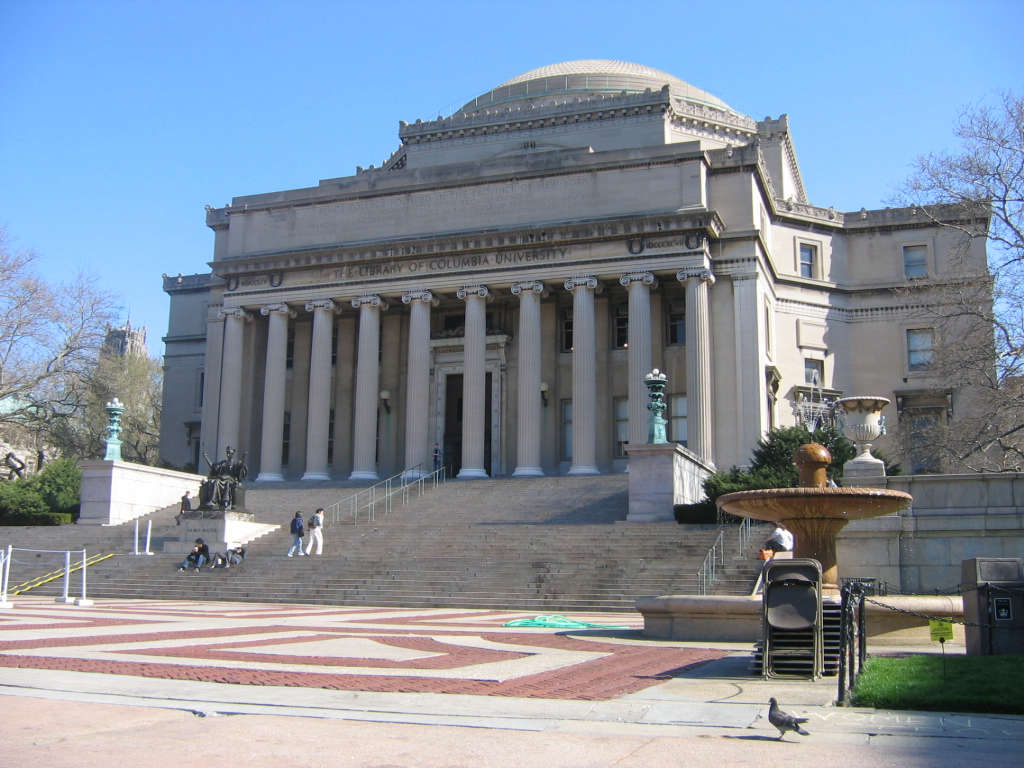
The thing is, our culture seems to have a congenital, hereditary disease to do just that. Just look at the Low Library here at Columbia--though don't be fooled, it's actually not used as a library now (photo credit Wikipedia):
The Low Memorial Library. Now where have I seen that before?....


Think it looks familiar? Well, it should. Not only is it modeled on the Pantheon in Rome:

Ah, yes, the Pantheon...hmmm...See what I mean?

 But it also happens to look like every other neoclassical building built--not in the first or second century AD--but in the nineteenth or even twentieth century, which abound in New York City. One nineteenth-century real estate magazine, detested by Low Library, even wrote, "there is scarcely any original designing done in this city, except the vagaries of the incompetent. The rest is mostly a copybook reproduction of classical and other detail" (qtd. in The New York Times, Feb 17 2002). And Columbia is full of such buildings. Just look at Bulter, the main library. Now, don't get me wrong, it's beautiful, especially at night; but isn't there something rather pretentious about using a neoclassical model, complete with the names of classical and and classic authors inscribed above its columns, for a building completed in 1934? Columbia, it would seem, had a bit of an identity crisis, after it moved from Park Place, to 49th Street, and finally to Morningside Heights in 1896; with no original buildings to its name after the latest move, it was the landless younger brother in  in an Ivy League governed by architectural primogeniture, so to speak.

But then again, who am I, the proud Princetonian, to scoff? After all, my alma mater literally has stones from Oxford colleges cemented into Firestone Library. Its Graduate College tower is practically an exact replica or that of Magdalen College, and the cloisters of Rocky/Mathey? Well, they have New College, Oxford written all over them. Can we say architectural envy?

I find this insatiable desire to connect with the old, or the ageless, fascinating, given the simultaneous, seemingly equally insatiable desire for progressiveness. These institutions are at the cutting edge of research and education, and they want to show it. I get daily emails about exciting events: forums discussing the Middle East, conferences on epidemiology, and lectures regarding new literary fields (disability studies--who knew?). (Side Note: This is, by the way, a typically American value; the idea of progress for progress' sake does not exist in most countries. I discovered in England that my British friends could just not relate to my stories of motivational middle-school mantras like "Yes we can!" and "If you believe it, you can achieve it." I can't imagine why...)

Yet at the same time universities' profound inability to wrench themselves from admiration of the past is embedded within their very stones. Ambivalence is literally constructed into the fabric of our universities, and our culture as a whole.

So what do we do now? To be honest, I'm not entirely sure. But I don't think we should deny the ambivalence, forget our duty to the past, or blind ourselves to the future. Haven't we seen enough of all variants of this in recent politics? By all means, make progress, but only with a firm grasp of what has come before, and what can be done with it. Think Shakespeare, not maggots.

Sunday, 15 January 2012

Bringing Forth Fruit: A Prelude

Me, in all sincerity, to a friend several years ago: "I could live anywhere but New York City." 


Look at this sentence. Now back to the blog title. Now back to the sentence. Now back to the title. 


God's irony is cruel sometimes.


I say this half in jest. Truly, despite visiting New York multiple times during college, my vagabond shoes did not long to stay. Wicked on Broadway, Placido Domingo at the Met, Chinese New Year in Chinatown--all of these had failed to seduce me into an urban liaison with Sinatra's metropolis. It was not big cities in and of them selves. I decided after two months in Paris I could live there forever, its arrondissements distilling all its charm and history into manageable size, so as to be accessible even to the naive foreigner. London--not quite as charming, but still pervaded by a class and sense of heritage that only comes from a nation one thousand years old. And it has Ben's Cookies, the finest cookies anywhere in the entire world, hands down. New York, on the other hand, had not yet secured my affections. 


Nevertheless, when graduate school applications rolled around, I applied to Columbia University, lured by its English faculty and its proximity to Princeton (once a Tiger, always a Tiger...). I ranked it solidly among the six solicited schools to which I would be thrilled to be accepted, as opposed to several decent, yet less desirable "safety" schools. Yet in my mind I had not yet made the connection that Columbia=New York, and me=not New York. 


This connection revealed itself in all its brutality, though, when I was accepted into Columbia's Ph.D. program. Suddenly I was forced to confront the fact that I could be spending the next six years of my life in the one city I had rejected as utterly uninhabitable. This was at the forefront of my mind on the campus visiting day, when the department flew me in (from Oxford!) in order to woo me with congenial students, incredibly impressive professors, and tasty Mediterranean food representative of the area's cosmopolitanism (served in a professor's fabulous studio apartment). 


I was pleasantly surprised, then, to discover that Columbia's campus was in fact a campus, though not nearly so sprawling and idyllic as Princeton (famously dubbed "the pleasantest country club in America" by F. Scott Fitzgerald '17 in This Side of Paradise). And Columbia is sandwiched in between not one, but two parks, Riverside and Morningside. Plus, it is close to Central Park, only about six blocks southeast; there were trees in New York after all! Morningside Heights, then, is not Times Square; it is distinctly different from midtown or downtown Manhattan. I thus accepted Columbia's offer contentedly, hopeful--if not altogether confident--that I would somehow be able to eke out a comfortable existence in my least favorite city. 


After living here for six months, remnants of my old attitude remain. I don't know if I will ever truly love or miss the City, or if I will ever forget the sight of a beautiful night landscape rendered fully visible solely by the light of the stars and moon. Such an experience does not and cannot exist in New York City. Indeed, so inconceivable is such existence amid the urban light and vertical architectural cacophony that I did not realize until I returned to Minnesota that I had not seen the moon at all in almost five months. Still, every once in a while I am reminded of the London of William Wordsworth's Prelude, that "monstrous ant-hill on the plain / Of a too busy world…[an] endless stream of men, and moving things," wherein all people are “melted and reduced / To one identity.”


Yet these months have shown me aspects of the city that I did not anticipate. As in Paris, where I prided myself on my intimate knowledge of the city's markets, I took great comfort in discovering the best and cheapest places for groceries in the Upper West Side. And as in London, my runs have provided a detailed mental map of the paths through the City's many public parks. 


Moreover, God has shown me--once again--that I am exactly where He always planned me to be. I have written elsewhere of my theme verse for Princeton, Philippians 1:6, painted in red, trimming the walls of my dorm room senior year: "Being confident of this very thing, that He which hath begun a good work in you will perform it until the day of Jesus Christ." Looking daily at this verse reminded me that my present and future are not part of some amorphous, seemingly errant Odyssey; they are but the continuation of a plan that God has been working since before I was aware of Him, before He even knit me together in my mother's womb. 
This path, then, has led me to New York, the Big Apple. Here is where I will spend, roughly, the next six years of my life, where I will enter, presumably, academic maturity, where all the skills I have fostered and gifts I have received, hopefully, will blossom into...what? Thistles, vainglorious self-aggrandizement bleeding those that would hinder its progress? Brambles, unconscious self-absorption producing nothing for the betterment of the world?


I sincerely hope, I hope with all my heart, not. I would blossom into fruit, into the most luscious, succulent grapes the academic world, indeed any world, has ever seen; grapes that provide sustenance to my friends, colleagues, students, and teachers, bursting with the sweetness of literature and all the Christlikeness of the engrafted vine. I was overcome while reading the Princeton Alumni Weekly today with a deep sense of obligation. No, not of obligation, of recognition, a recognition of the privileges I have received and the opportunities to which I am parcel. The providence evidenced in these opportunities creates great gratitude, and with this gratitude comes a desire to inspire change and please God even more than Jodi Picoult '87 does her readers, or Anthony Marx *86 *90 does the patrons of the New York Public Library. 


I realize this dream reeks of all the naive idealism of youth, privilege, and late night insomnia. Nevertheless, I would not give it up. Rather, I would press it close to my chest, and keep it forefront in my mind. My greatest fear is finding that after six years my time in the Big Apple has been wasted. I would have it otherwise, that six years will see the bringing forth of much fruit, fruit by which the tree--the Tree--is known.